
Concrete Driveway Cost in Missoula: New vs. Replacement
Understand driveway cost, measure your project, compare installation with replacement, and use a bid worksheet to check what each estimate includes.
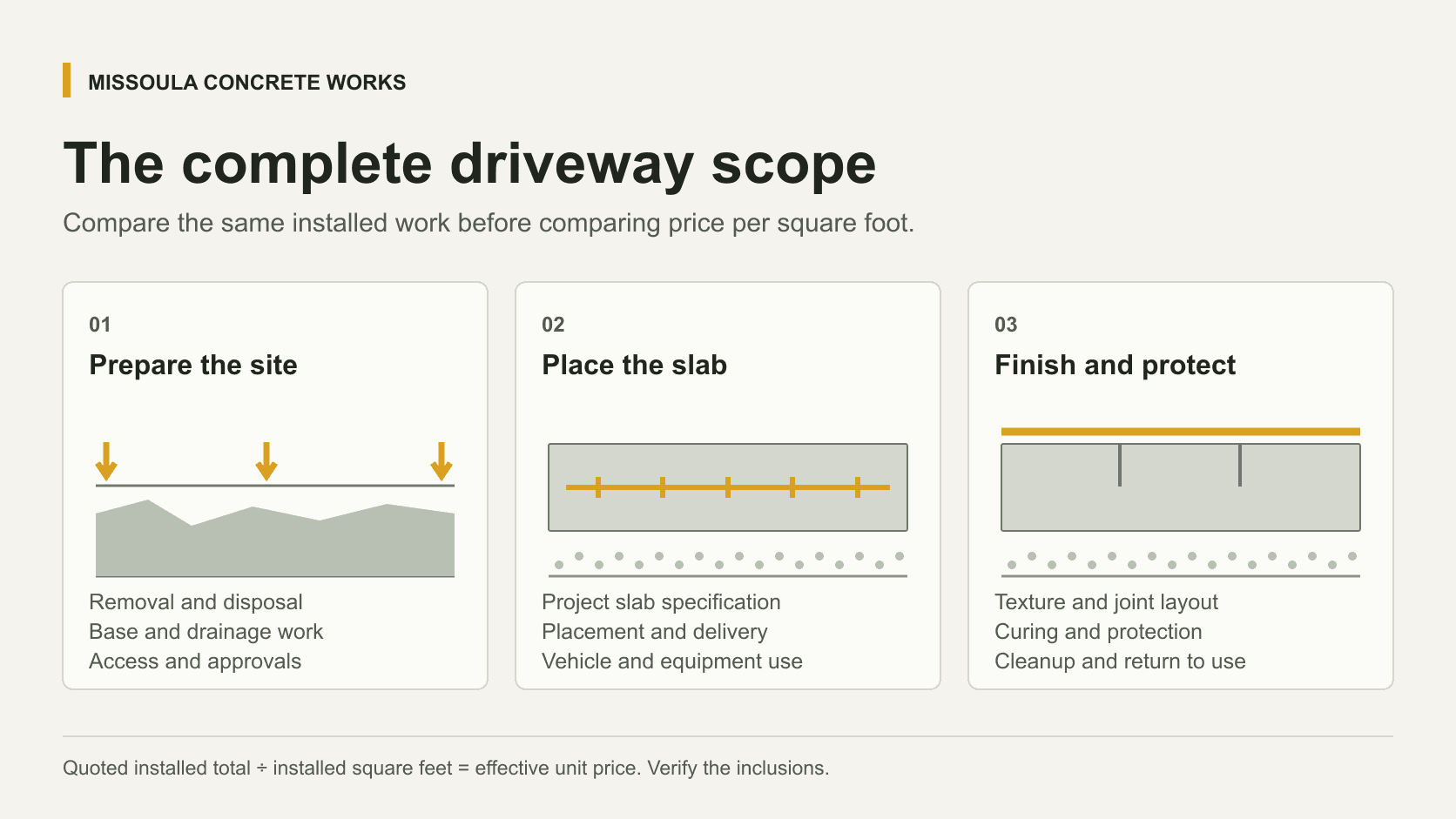
The cost of a concrete driveway in Missoula depends on the complete installed scope: removal if needed, base and drainage work, the slab specification, placement access, finish, and curing. Square footage is a useful starting point, but two equally sized driveways can be very different jobs.
Missoula Concrete Works prices the actual site rather than publishing a fixed square-foot rate that may leave out preparation. This guide helps you measure the project, distinguish a new pour from replacement, and compare written estimates. If you already have quotes, use the comparison tool below to calculate their effective price per square foot, then check that the included work matches.
Measure the driveway before comparing prices
For a rectangle, multiply length by width in feet. A driveway measuring 20 feet by 30 feet has a 600-square-foot footprint. That example describes area only; it is not a standard driveway size or a price estimate.
For a driveway with a widening apron or parking extension, sketch it as separate sections. Measure each rectangle and add the areas. Label approximate or irregular sections so the estimator can verify them. Also mark the garage door, street connection, sidewalks, steps, and any area you want to keep.
| Section | Length × width | Area |
|---|---|---|
| Main rectangle | 20 ft × 30 ft | 600 sq ft |
| Separate parking extension | 10 ft × 12 ft | 120 sq ft |
| Combined footprint | Two non-overlapping sections | 720 sq ft |
Keep proposed new area separate from the existing area to be removed. A larger replacement may have one demolition quantity and a different installation quantity. That distinction prevents confusing bid comparisons.
New driveway vs. replacement: what changes?
A new driveway
A new installation starts by establishing the layout, finished elevations, access, and the condition of the ground. Existing gravel does not automatically mean the base is ready. The estimate should explain what material stays, what comes out, what preparation is included, and how the new surface meets the garage and street.
A replacement driveway
Replacement adds removal and disposal of existing pavement. Concrete thickness, reinforcement, adjacent surfaces, and access affect that work. The old driveway also provides clues: settled panels, water near the garage, or repeated patches should be considered in the replacement plan.
Ask how conditions discovered after demolition will be documented, priced, and approved. An allowance for base correction is different from a fixed inclusion, and neither should be hidden behind the phrase “prep included.”
A partial replacement or extension
A smaller project may make sense when the surrounding driveway is worth keeping. It still requires equipment, delivery, forming, finishing, and workable transitions. Compare its total scope rather than assuming a small area will have the same unit price as a much larger pour. See our repair-versus-replacement guide if the main question is how much concrete needs to come out.
The details that change an installed driveway price
1. Demolition, removal, and disposal
Specify whether the bid removes concrete, asphalt, gravel, or a combination. Ask whether cutting at the removal boundary, haul-off, disposal, and protection of nearby steps or foundations are included. A bid for new concrete alone should not be compared with a complete tear-out and replacement total.
2. Subgrade, base, and drainage
Ask what the contractor expects to find beneath the driveway and what base preparation is included. The finished surface also needs a defined drainage path. Correcting grade or removing unsuitable material changes the project even when the new driveway keeps the same footprint. Excavation and site preparation should be coordinated with the pour.
3. Thickness, reinforcement, and intended loads
List what will use the driveway: passenger vehicles, delivery traffic, trailers, trucks, or an RV. Ask for the proposed slab thickness and reinforcement in writing, with any changes for the intended use. A surface specified for light parking is not automatically interchangeable with one designed for heavier loading.
More reinforcement does not create a crack-free guarantee. NRMCA’s cracking guidance treats support, joints, placement, and curing as part of the overall result. Price comparisons should include those details alongside the concrete specification.
4. Placement access and protection
Can delivery and removal equipment reach the work? A steep approach, tight gate, overhead obstruction, protected landscaping, or long placement distance can change the method and labor. Ask whether pumping or other placement equipment is included, optional, or priced separately if needed.
5. Finish, shape, borders, and joints
A straightforward broom finish and a decorative layout involve different decisions. Confirm texture, color, borders, curves, and how decorative work interfaces with joints. Compare like finishes, and ask about traction and maintenance when considering stamped or sealed areas.
A proposed joint layout helps you understand the finished surface. NRMCA explains the role of contraction and isolation joints. Ask how joints and transitions will be handled rather than pricing the driveway as an uninterrupted sheet.
6. Permits, inspections, and the street connection
Within city limits, review the City of Missoula’s private paving and right-of-way permit guidance. A driveway approach or sidewalk connection may involve a different process from the private portion. Confirm responsibility for applications, fees, and inspections for your exact scope. County and other nearby jurisdictions may differ.
7. Weather, curing, and the return-to-use plan
Ask what protection and curing are included, how weather affects the schedule, and when your specific vehicles can return. Curing manages moisture and temperature so concrete can develop its intended properties; cool conditions can slow strength development. NRMCA’s curing guide explains the process. A surface that looks dry is not a loading test.
Our Missoula seasonal planning guide helps you plan timing, while the contractor’s instructions establish the actual return-to-use schedule for the pour.
Compare written bids line by line
Copy this checklist into your notes. For each item, record “included,” “excluded,” “allowance,” or “not specified,” then resolve the unknowns before choosing a contractor.
| Bid item | What to confirm |
|---|---|
| Measured scope | New area, removal area, layout, and sections remaining |
| Removal and disposal | Cutting, demolition, haul-off, disposal, and site protection |
| Base preparation | Included excavation, base material, compaction, and hidden-condition process |
| Drainage and elevations | Finished heights, water destination, and any separate drainage work |
| Slab specification | Thickness, concrete requirements, and reinforcement for your vehicle use |
| Finish and joints | Texture, decorative work, boundaries, and joint layout |
| Access and approvals | Placement equipment, permits, inspections, and utility locating responsibility |
| Curing and cleanup | Protection, return-to-use instructions, and disturbance restoration |
| Commercial terms | Written total, allowances, payment schedule, change approval, and any stated warranty |
Calculate the effective unit price as quoted installed total ÷ installed square feet. Use that number only after matching the scopes. A low unit price with demolition excluded can cost more overall than a higher unit price that covers removal and base correction.
Project worksheet
Compare your driveway estimate totals
Enter your quoted totals for the same installed area. This calculates price per square foot; check removal, base work, finish, and exclusions before comparing value. You can enter one estimate at a time.
Add the installed area and at least one quoted total to see its effective unit price.
What if the total is above your budget?
Ask for options that preserve the necessary preparation. A simpler finish, a smaller useful footprint, or a defined section replacement may change the total. Ask how staging changes mobilization and transitions rather than assuming multiple small pours cost the same as one coordinated project.
If you are open to a different material, discuss asphalt driveway options using the same removal, base, drainage, and access assumptions. Material comparisons should account for maintenance and intended use as well as installation price.
Prepare one clear estimate request
- Project location and rough dimensions, with a simple sketch if the shape is irregular.
- Photos of the whole driveway, garage transition, street connection, and access route.
- Existing surface, visible damage, and any known history of repairs or settlement.
- Water problems you have observed, including runoff after rain or snowmelt.
- Vehicle types and whether you want an extension, apron change, or different parking layout.
- Finish preference and the dates when daily vehicle access is essential.
- Known buried irrigation, private utilities, or other constraints near the work.
Before digging is planned, identify who will arrange utility locating. Montana 811 notes that private underground lines may need separate locating; existing marks do not tell you every irrigation or customer-owned line is covered.
Questions about concrete driveway pricing
Can you give me a price from photos?
Photos and dimensions help define the first conversation, but access, elevations, removal, and base conditions may need a site visit. Identify any assumptions in an early estimate before treating it as a final total.
Is a square-foot quote the complete price?
Only when the written scope says what that rate includes. Ask specifically about removal, base work, placement equipment, permits, and cleanup, plus how unexpected conditions are handled.
Should I replace the whole driveway to fix one panel?
Not automatically. An isolated replacement may fit when the surrounding concrete remains serviceable and the cause can be corrected locally. A wider assessment is useful when several areas move or drainage needs to change.
How do I get a Missoula Concrete Works estimate?
Send your driveway details with the location, rough dimensions, current surface, photos, vehicle use, and timing. We can discuss driveway installation or replacement based on the actual project.