
Concrete Repair vs. Replacement in Missoula
Decide what to do with a cracked driveway, patio, or walkway: compare surface repair, panel replacement, and a full rebuild, then prepare for a useful estimate.
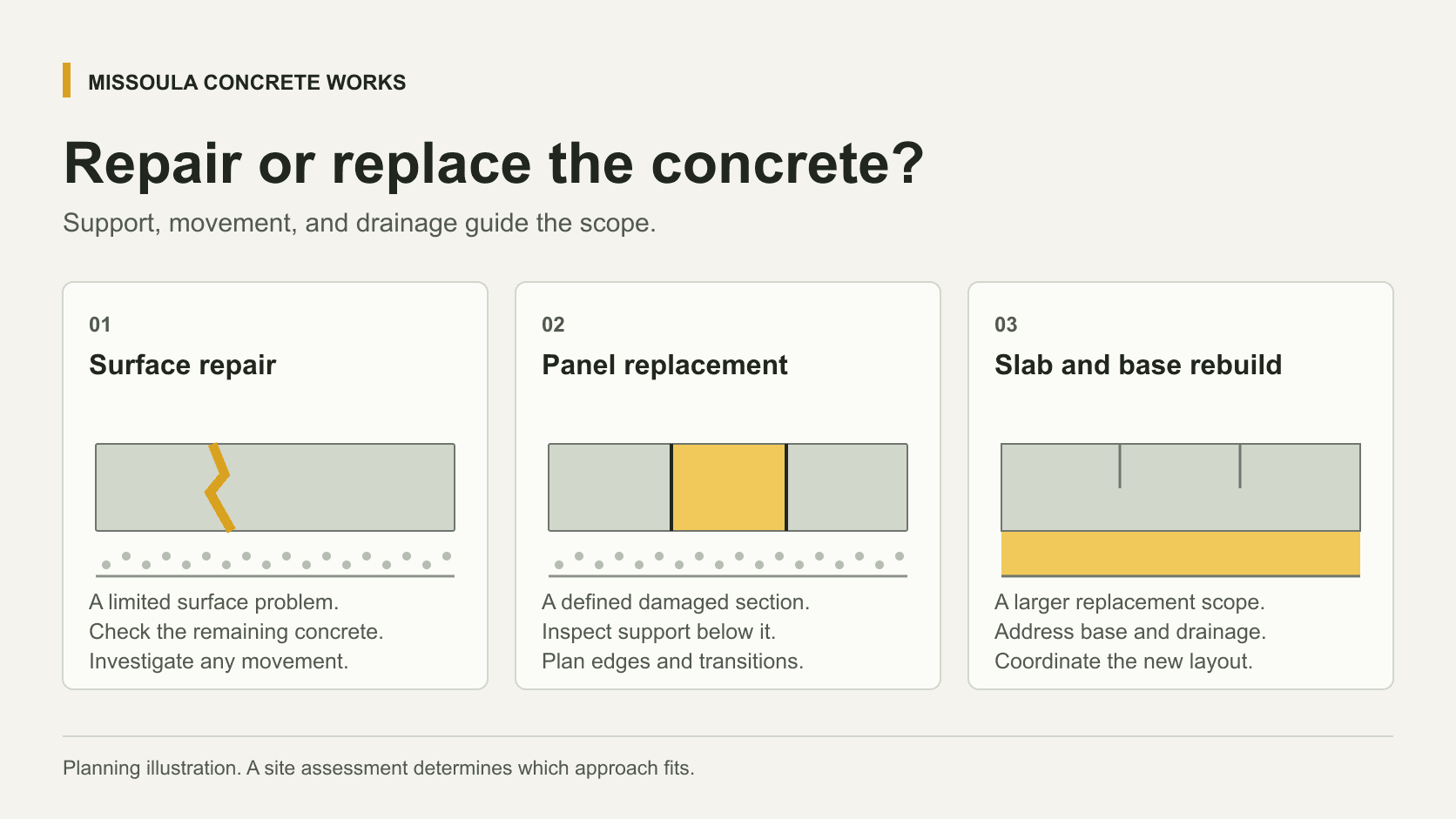
A crack by itself does not tell you whether concrete needs replacement. The useful questions are whether the surface is still supported, whether adjacent panels have moved, where water goes, and whether the damage is isolated or repeating across the slab. A stable surface flaw and a driveway sinking toward a garage need different scopes.
For a Missoula driveway, patio, or walkway, repair is worth considering when the remaining concrete is serviceable and the cause can be addressed locally. Replacement becomes more compelling when several panels move, the slab drains the wrong way, or deterioration leaves too little sound concrete for a lasting repair. Use the comparisons below to prepare for an assessment, rather than diagnosing a slab from a photograph alone.
Repair or replace? Start with these observations
| What you observe | What to investigate | Scope to discuss |
|---|---|---|
| A fine surface crack; no visible height change | Whether it is stable, superficial, or changing | Monitoring or a suitable surface repair; replacement may be unnecessary |
| One broken or displaced panel; neighboring panels still work | Support below that panel and its drainage or root conditions | Defined panel removal, base correction, and replacement |
| A sunken but otherwise intact slab | Voids, water movement, and whether the slab can be lifted | Assessment by a lifting specialist or removal and replacement |
| Water collects or runs toward a building | Finished elevations, runoff sources, and available drainage path | Grade or drainage correction; patching alone may leave the problem |
| Several panels move, break, or repeatedly fail | Extent of support loss and condition of the remaining concrete | A larger replacement scope with base and drainage work |
| Cracks extend into a foundation, wall, or structural element | Whether movement involves the structure | Structural assessment before treating it as ordinary flatwork repair |
Read the damage before choosing a method
A crack with no visible movement
Concrete changes with moisture and temperature, and cracks have several possible causes. Joint layout, support, finishing, and curing all matter; reinforcement does not make concrete crack-free. NRMCA’s guide to concrete cracking explains why the crack pattern needs context. Note when you first saw it and whether it has changed.
Take a close photo with a ruler beside the crack, plus a wider photo showing the whole panel. Photograph the same location again if you notice a change. Do not choose a repair solely from an online crack-width threshold: depth, movement, location, and intended use affect the decision.
One edge is higher than the other
A height difference deserves a different conversation from a flat hairline crack. Ask whether a panel has settled, lifted, or lost support. Look at the surrounding site: a downspout, wet low spot, tree, recent trench, or change in grade may be relevant. Share what you have observed without assuming the cause.
The top surface is flaking
Surface flaking, often called scaling, is different from a full-depth break. Moisture, freezing exposure, deicers, and installation practices can influence it. A bonded surface repair needs sound concrete beneath it; advanced deterioration may make that approach unsuitable. See NRMCA’s scaling guidance for the distinction.
A fine web of shallow surface lines
A network of small surface lines can be crazing. NRMCA describes crazing as a surface condition, generally different from structural cracking. An assessment should distinguish it from cracks associated with movement before you commit to demolition.
Compare repair, panel replacement, lifting, and resurfacing
Surface repair or crack treatment
A compatible repair material may address a limited surface defect or help manage an opening. It does not restore support below a moving panel or change the direction a driveway drains. Ask what the treatment is meant to accomplish, how movement affects it, and what appearance to expect. A visible repair can be a reasonable tradeoff when the slab still functions.
Panel or section replacement
For isolated damage, concrete panel replacement creates access to the material below the failed section. The scope can include defined removal, correction of unsuitable base material, and new concrete tied into the remaining layout. The estimate should identify the removal boundary and how the replacement meets neighboring surfaces.
Replacing a complete defined panel can be more practical than leaving small irregular patches around a break. That is a layout decision for the specific slab, not a rule that every crack requires a whole new panel.
Concrete lifting or leveling
Lifting is a specialist method for raising suitable settled slabs. It can be worth investigating when the slab itself remains serviceable. It is a different scope from removing and repouring concrete. Ask the lifting provider to assess the cause of settlement, the target elevation, drainage afterward, and what happens if movement continues.
Missoula Concrete Works’ service described here is assessment, removal, base correction, and replacement where appropriate. Discuss lifting with a provider offering that method rather than assuming it is included in a replacement estimate.
Resurfacing or an overlay
An overlay changes the surface of existing concrete. It depends on the substrate and product requirements, and it does not eliminate ongoing slab movement. Before comparing it with replacement, ask how existing cracks and joints are handled and how the added height affects doors, steps, and transitions. Confirm suitability with the installer and material manufacturer.
Full replacement
Full replacement offers a chance to rebuild the layout and address problems below or beside the concrete. It is worth discussing when isolated work would leave several failures, poor elevations, or an unworkable drainage path. It also brings demolition, disposal, access, and a new period of restricted use, so the scope should justify those costs.
Missoula planning: water, winter, and repeat problems
Walk the site after rain or snowmelt if you can do so safely. Photograph water collecting near the garage door, along a patio edge, or beside a walkway. Note whether downspouts or irrigation discharge into that area. A dry-day visit can miss water patterns you have already seen.
Ask where the finished surface will send that water. “Away from the house” is a goal; the project still needs an actual destination that respects neighboring properties and existing drainage. Your observations help scope grading and base correction alongside the concrete work.
If an earlier patch failed, tell the estimator when it was done, what was applied if known, and how soon the problem returned. That history helps distinguish another surface treatment from a scope that investigates underlying conditions.
What a replacement estimate should include
- Removal boundary: which panels or surfaces come out, and which remain.
- Demolition and disposal: cutting, removal, haul-off, and protection of adjacent work.
- Base and drainage: what correction is included and how hidden unsuitable material will be handled.
- New concrete: planned thickness, reinforcement, mixture requirements, finish, and joint layout.
- Transitions: connections to doors, steps, foundations, driveways, and sidewalks.
- Approvals and access: responsibility for permits, inspections, utility locating, and keeping a usable route.
- Return to use: instructions for walking, vehicles, equipment, and any later surface treatment.
Joint details deserve their own discussion. Contraction joints help control where shrinkage cracking occurs; isolation joints allow separation at selected adjoining elements. NRMCA’s joint guide explains why a replacement needs a planned layout.
A city sidewalk or driveway approach is a different approval situation from a private backyard patio. The City of Missoula’s engineering permit guide describes right-of-way construction and private paving permits. Confirm the applicable process for your address and scope; nearby county properties may have a different authority.
Compare cost by the work that remains afterward
A patch, a lifting estimate, a panel replacement, and a full rebuild are not interchangeable bids. A lower upfront price is useful only if the proposed work addresses your goal. Compare the area corrected, remaining defects, drainage outcome, expected appearance, and exclusions.
Ask, “What problem will still be here when this work is finished?” Also ask how unexpected conditions below the concrete change the price and who approves that additional work. For a driveway, our driveway cost and bid-comparison guide gives you a more detailed worksheet.
Prepare five photos and a short project note
- A wide view showing the entire driveway, patio, or walkway.
- A close view of damage with a ruler for scale.
- A side view showing any height difference between panels.
- The nearby door, building edge, steps, and water path.
- The equipment access route, including gates or tight corners.
Include approximate dimensions, location, when damage appeared, whether it changes seasonally, previous repairs, and how the surface is used. Say whether you need a temporary pedestrian route, daily vehicle access, or coordination with other work. Do not enter an unstable area to collect photos.
Common repair questions
Can one driveway panel be replaced?
Sometimes. The remaining panels must be worth keeping, and the failed section needs a workable removal boundary, base correction, and transition. A visit establishes whether an isolated replacement is sensible.
Will the new concrete match the old concrete?
Do not assume an exact match. Existing weathering, mixture, texture, and earlier treatments affect appearance. Ask how the boundary and finish will look before approving a visible section repair.
Does every crack mean poor workmanship?
No. A crack can have several causes, and appearance alone does not establish responsibility. Assess the pattern, movement, support, drainage, and project history together.
Can I drive on a replacement as soon as it looks dry?
A dry-looking surface does not establish readiness for vehicle loads. Get project-specific return-to-use instructions and arrange parking around them. Our seasonal concrete planning guide explains the scheduling considerations.
Request an assessment with a clear goal
Tell us whether your priority is removing a trip hazard, correcting drainage, replacing failed concrete, or planning a larger improvement. Request a concrete repair estimate with your location, dimensions, photos, and access needs. We can discuss the scope without assuming every damaged slab needs the same solution.